Sometimes I feel like it has only been a couple of years since I entered the international school world, but it has already been five. Reflecting on my journey through corridors supposed to overflow with multiculturalism, diversity, and equity, I realize how this applies mainly to the student body but is not entirely true for the staff. There is a long way we still have to go. “We” meaning teachers and all the machinery that makes international education what it is today, including directors, recruiters, administrators, and recruitment platforms, to name a few.
I have not yet had the opportunity to enjoy the advantages of being an international teacher hired as an expatriate, so my perspective comes from a local employee’s lens, with full knowledge of international hires’ benefits. My situation is even a little more singular, since I am a foreigner hired as a local, which is not uncommon; the expatriation process has to occur for you to be considered a foreigner. It does not matter what your credentials or experience are, but from where you were “imported.”
Let’s exemplify it. I am Venezuelan and have been living in Panama for some years now. I am a Computer and Systems Engineer with a Master’s Degree in Education. Let’s suppose that my twin brother, Luis Carlos II, with the same credentials as me, lives in Venezuela. An international school in Panama decides to hire us both. My twin brother will receive an offer quite different from mine. He will receive a paid ticket to move to Panama, and the school will cover all legal expenses for visas and work permits, housing included. At the time of relocation, the school will pay the accommodation expenses. The school will cover transportation for the first days until he gets a car. He will not pay taxes on his salary, and if he travels with a partner, he will likely receive an extra amount of money for the dependent and children. Besides that, there are bonuses for renewing the contract at the end of each year and fixed annual bonuses for debt consolidation in the country of origin, like mortgages or education loans, to mention a few.
Meanwhile, I, Luis Carlos I, who was already in Panama, will have a lower salary, and the tax deduction will apply to me. I will not receive bonuses or housing, despite the money that the school will already have saved on air tickets, legal procedures, etc. The only difference being that I was already here, in Panama, and my twin in Venezuela. And that is how international school recruitment works.
A few days ago, a co-worker, previously in the same situation as me and now an expatriate in an international school in India, sent me the link to an article that made me think even more about this issue. The title, “Are you white enough?”, says a lot on its own.
As a local hire, I have tried to get a job as an ex-pat in other countries, but the recruitment fairs are expensive and involve traveling. A local hire’s contract doesn’t include the option to request four days off to attend these fairs, as ex-pats’ contracts do. Two years ago, an international school recruitment fair was held for the first time in Latin America and for the first time in Panama. Since I did not need a hotel or a ticket to go to one of the cities where these fairs usually occur, such as Bangkok, Hong Kong, London, Cambridge, or San Francisco, I decided to attend.
As international teachers who have been through this process will know, these fairs are intimidating. Fortunately, I wasn’t alone; my partner, also a teacher, went with me. Hundreds of candidates and dozens of schools recruiting. We had the opportunity to be interviewed for positions at a school in Mexico. We applied to other schools too. You get in line in front of the table with the recruiters for that school. You watch the other people in front of you, maximizing those minutes you get to try to sell yourself the best you can. When it was finally our turn, the interactions mainly looked like this:
- “We cannot hire Venezuelans”;
- “Are you Luis and Eduardo? Your profiles are perfect, but with your Venezuelan passports, it would be almost impossible to hire you.”
- Or simply a finger pointing to a note written at the top of your resume: “Venezuelan.”
I encourage you to take the time to visit any international school website and see how they boast of having more than 40 nationalities in their student body and more than 30 nationalities in their staff. A bit contradictory, right?
Some time ago in COETAIL, we were exposed to an interesting article about Bobbie Harro’s Cycle of Socialization. Here you can read The Cycle of Socialization. I also wrote a previous post about it, with a video based on the article.
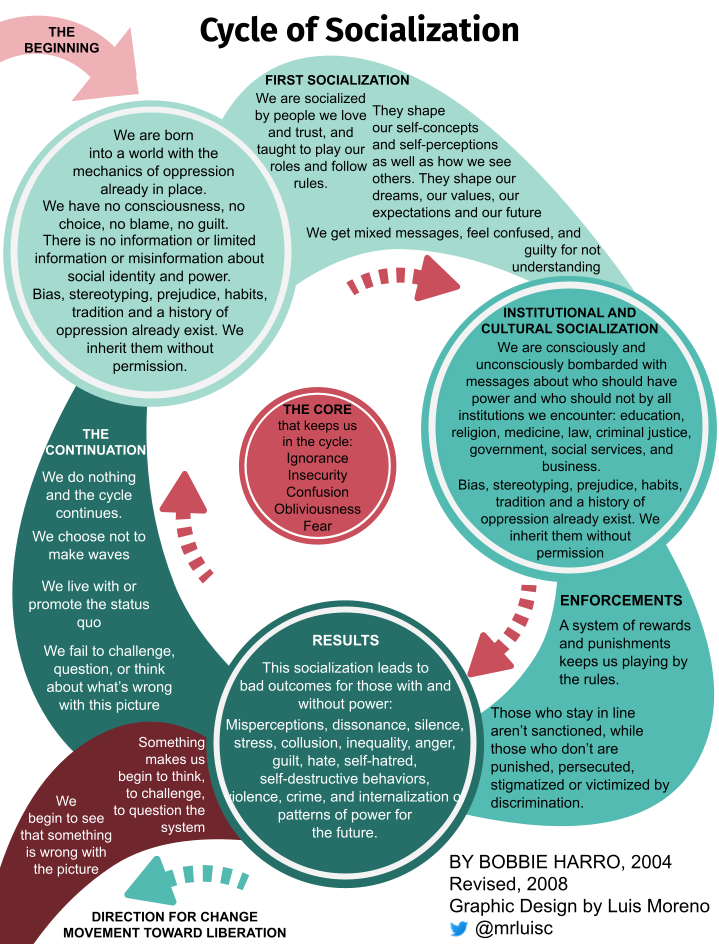
There is the possibility that later it will be me who enters the international school circuit. I can’t stop thinking that I will contribute, in a certain way, to perpetuating this cycle. I hope it will also help weaken the paradigms of hiring based on skin color, nationality, sexual orientation, and native language. Whatever the outcome, I wanted to use this opportunity as a personal intent to break the core of this cycle, putting fear and conformity aside, and using my voice to inform, combat ignorance concerning this issue, question the system, and speak up!
First published on my COETAIL blog on 24 March 2021, lightly edited for this site. Some of its images are not included here. Read the archived original.