When I started reading the resources provided for “From Theory into Practice”, the first thing that came to mind was the intro from the documentary “Most Likely to Succeed”. I watched it as part of a professional development course on Project Based Learning (PBL) that I attended, and it made me think about how we must update our education system to fit the needs of today’s world. Here is the trailer of the film, which I recommend to educators and non-educators alike.
Most Likely To Succeed from Innovation Playlist on Vimeo.
Much of the documentary specifically talks about the PBL approach and shows High Tech High students in San Diego, California, being exposed to a non-traditional educational system. However, at the beginning of the film, they briefly show the origins of the education system, which has kept the same structure for almost the whole of the last century. Obviously, technology has unavoidably been embedded in our classrooms since then. Now, even outside of campus and at an accelerated rhythm due to COVID-19 school closures, massive online learning is pushing the transformation of our educational environments.
This unprecedented event has definitely reshaped, and will continue to change, the way things are done in many fields. In education, it is forcing a large percentage of teachers into constant professional development, learning every day about technology use, tools, and strategies so as to be better equipped with skills and improved toolkits. This is a process that could have taken years at a regular pace. This forced improvement, hopefully, will take us one step closer to meeting the needs of our modern-age students.
Having students attend classes, memorize concepts, and demonstrate their knowledge through test completion may have worked perfectly at a time when most of the workforce was only expected to complete repetitive tasks, but it does not work in today’s scenarios. As George Siemens explains in his article, Connectivism: A Learning Theory for the Digital Age:
“Learners as little as forty years ago would complete the required schooling and enter a career that would often last a lifetime. Information development was slow. The life of knowledge was measured in decades. Today, these foundational principles have been altered. Knowledge is growing exponentially. In many fields, the life of knowledge is now measured in months and years.”
In today’s context of constant innovation, a new approach to education is needed. Our focus should shift toward teaching students how to learn rather than what to learn, so that they are prepared with the tools and skills needed to deal with the tasks of tomorrow in more creative and innovative ways. Not only is this necessary, but the spaces where learning happens should also be expanded. Online spaces need to be considered an important element in educational agendas.
The online spaces I am referring to are called networked publics by various authors and academics. According to Danah Michele Boyd in her article Taken Out of Context: American Teen Sociality in Networked Publics, “networked publics are simultaneously (1) the space constructed through networked technologies and (2) the imagined community that emerges as a result of the intersection of people, technology, and practice.”
The current pandemic is exposing students, teachers, and parents to new school dynamics involving a lot of technology and making us all part of these new online communities, but we are far from taking advantage of networked publics in a way that will transform education. There are at least two important bridges that need to be built for this to happen. The first is the one we adults (parents and teachers) need in order to connect with young people and truly understand, respect, and acknowledge that the way they interact nowadays is valid (although different from what we are used to). The second must be built between school life and social life. Even when students are using networked publics at school, they are not using them for school. We need to entice students to spend as much time on their academic online life as they do on their social online profiles. But how?
There are numerous variables to consider and many stakeholders that must be involved to achieve this change. As always, many of these variables and actors are beyond our direct control: laws, government, coronavirus (read in Cardi B’s voice). But luckily, there are some things that we can control or at least influence. There are two tools I remember, thanks to my great friend and colleague Sarah Snack, when I think about complex change issues like these. The first, which we could use to manage change on a smaller scale within our schools, is a framework for change management: the Knoster Model for Managing Complex Change. But the tool I consider more effective to relieve the anxiety that arises from facing variables we cannot control is a concentric circle diagram: circles of control and influence. So, I used their template to create my own:
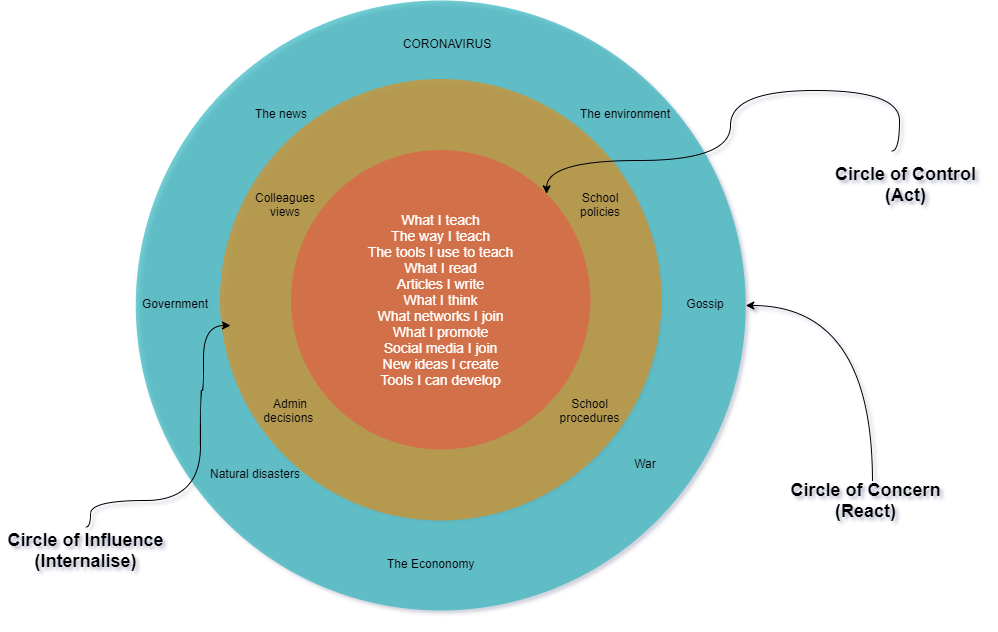
I am an international teacher, fortunate enough to work in a well-positioned and widely recognized school with all the physical and human resources necessary to become a point of reference for other schools and institutions, locally and internationally. I feel that we have a responsibility to our students and the education community to use these tools to be pioneers. We must recognize, as individuals and institutions, that although this is not necessarily the best time for all schools to make these changes, we will eventually be a reference and guide for them when the time comes.
First published on my COETAIL blog on 9 April 2020, lightly edited for this site. Read the archived original.